“A Purpose Driven Folly” or why Rick Warren should really check out Bible Hub.
I hate that I have to actually say this, but overlap does not equal sameness.
Our lives are endlessly complicated by the pervasive violation of this simple, unchanging truth. The overlap of two things is often exploited and magnified to advance an agenda, thus creating endless confusion, tension, frustration, and I fear soon, increased violence.
So what does this have to do with Rick Warren and Bible Hub?
If you haven’t heard, three years ago Rick Warren changed his opinion on female ordination and preaching. He now believes it is biblical to ordain women, make them preachers, and give them authority over men. He got his church kicked out of the Southern Baptist Convention over it.
Recently he shared his reasoning in the video below.
He makes several arguments for it. I want to focus on one of them in particular for this article. I chose this one because it perfectly demonstrates the truth that Overlap does not equal Sameness.
He says the following in support of his change of belief about female ordination and preaching:
“…The very first Christian sermon, the message of the Gospel of the good news of the resurrection, Jesus chose a woman to deliver it to men. He had Mary Magdalene go and tell the disciples. Now that clearly wasn’t an accident. It was intentional. It’s a whole new world, baby.”
His intent with these two sentences is to provide persuasive justification as to why he now believes women can be ordained, and preach, despite what 1 Timothy 2:12, 1 Corinthians 14:34-35, 1 Timothy 3:1-7, and Titus 1:5-9, Acts 6:3-6, very clearly say and the examples they set.
I want to be clear about intent here. The purpose of this article is not to debate whether or not Women can preach or be ordained (they can’t, but more on that another time).
While there is much overlap to that larger issue, the purpose of this article is limited to the above quote by Rick Warren, and why it’s an unbiblical argument which should be disregarded. My hope and prayer is that it will help you, reader, in the development of your biblical discernment.
Let’s look at the texts he is referencing in his quote. He is paraphrasing from four nearly identical passages. I used Bible Hub for my research.
Mark 16:10 – She went and told those who had been with him, as they mourned and wept.
Matthew 28:8 – So the women hurried away from the tomb, afraid yet filled with joy, and ran to tell his disciples
Luke 24:9 – When they came back from the tomb, they told all these things to the Eleven and to all the others.
John 20:18 – Mary Magdalene went to the disciples with the news: “I have seen the Lord!” And she told them that he had said these things to her.
Notice any similarities in these passages? In all four instances, Mary Magdalene told the disciples what she had seen. In all four instances the same Greek word is used.
The word used in these passages for Told/Tell is ἀπαγγέλλω (apaggelló) – Strong’s 518.
It is defined as: “To report (from one place to another), bring a report, announce, declare.”
For context, here are some verses using the same word:
Acts 23:19 – The commander took the young man by the hand, drew him aside and asked, “What is it you want to tell (ἀπαγγέλλω) me?”
Luke 7:22 – So he replied to the messengers, “Go back and report (ἀπαγγέλλω) to John what you have seen and heard: The blind receive sight, the lame walk, those who have leprosy are cleansed, the deaf hear, the dead are raised, and the good news is proclaimed to the poor.
1 Thessalonians 1:9 – For they themselves report (ἀπαγγέλλω) concerning us the kind of reception we had among you, and how you turned to God from idols to serve the living and true God,
It is clear then, that ἀπαγγέλλω means simply to report to, or tell somebody something that you have seen, or have been told to share with them. It is to give a testimony or witness.
Let’s go back to Rick Warren’s statement:
”The very first Christian sermon, the message of the Gospel of the good news of the resurrection, Jesus chose a woman to deliver it to men. He had Mary Magdalene go and tell the disciples. Now that clearly wasn’t an accident. It was intentional. It’s a whole new world, baby.”
In his quote, Rick is asserting that Mary Magdalene, in her sharing/telling/reporting of what she saw at the tomb, she actually gave the first sermon of the Gospel.
So that begs the question, what do we call the act of sharing a sermon? I mean I know the answer, and so do you, but to be “safe” let’s just ask ChatGPT.
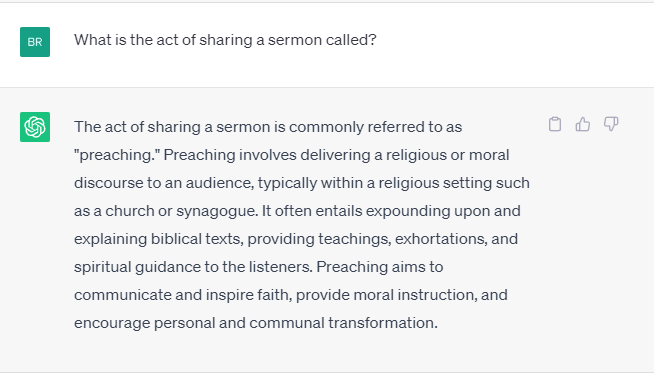
“The act of sharing a sermon is commonly referred to as “preaching.” – ChatGPT
That seems pretty clear. The act of sharing a sermon is called “Preaching.” You know that, I know that, ChatGPT knows that. Everyone knows that.
Next we must ask if preaching a sermon is the same act as telling somebody something important?
Let’s go back to the Greek.
There two Greek words commonly used to describe preaching in the NT. There is a third which is focused on teaching, but often paired with preaching.
The primary word for preaching in the NT is “”Kērussō” or kērýssō “” ” (κηρύσσω) – Strongs 2784 which is an authoritative, public teaching and preaching. It is used 61 times in the new testament.
Its official definition: “properly, to herald (proclaim); to preach (announce) a message publicly and with conviction (persuasion).”
2 Timothy 4:2 – Preach (κηρύσσω) the word; be prepared in season and out of season; correct, rebuke and encourage—with great patience and careful instruction.
Acts 10:42 – “He commanded us to preach (κηρύσσω) to the people and to testify that he is the one whom God appointed as judge of the living and the dead.
Mark 6:12 – “They went out and preached (κηρύσσω) that people should repent.”
The second most used word to describe preaching is “Euangelizō” (εὐαγγελίζω) – Strong’s number 2097. It is used 54 times in the new testament. It’s the original word for “Evangelizing” with a specific focus on preaching.
Acts 5:42 – “And every day, in the temple and from house to house, they did not cease teaching and preaching (εὐαγγελίζω) that the Christ is Jesus.”
Acts 16:10 – “After Paul had seen the vision, we got ready at once to leave for Macedonia, concluding that God had called us to preach (εὐαγγελίζω) the gospel to them.”
Finally, we have “Didachē” (διδαχή): Strong’s number 1322. It is used 30 times in the new testament. It has an emphasis on authoritative teaching. It is often paired with preaching in the new testament (hence the phrase “Preaching and Teaching.”)
Acts: 13:12 – Then the proconsul believed, when he saw what had occurred, for he was astonished at the teaching (διδαχή) of the Lord.
2 John 1:9 – “Everyone who goes on ahead and does not abide in the teaching (διδαχή) of Christ, does not have God. Whoever abides in the teaching (διδαχή) has both the Father and the Son.”
So far Preaching something and telling somebody something seem pretty different.
Lets pull the quote one more time.
“The very first Christian sermon, the message of the Gospel of the good news of the resurrection, Jesus chose a woman to deliver it to men. He had Mary Magdalene go and tell the disciples. It was intentional. It’s a whole new world, baby.”
See what Rick did there? It’s very clever. In his paraphrased summary of those four passages, he pre-supposes that her report of what she saw was a “sermon” and thus her act of delivering it and telling it, was “preaching.” He takes the overlap of verbal communication and delivering a sermon (preaching), then uses that to justify his argument that the two are the same.
But then it get’s even worse.
He uses these faulty conclusions based on pre-suppositions which are not consistent in the Greek to boldly declare that it was by divine providence (God’s will) that a woman “preach” the first sermon to men.
He presents this as irrefutable proof for his change of position on female ordination and preaching.
But why?
If in all four accounts, Mary Magdalene told (ἀπαγγέλλω) the disciples what she saw, and there is no reference to her preaching (κηρύσσω) or (εὐαγγελίζω), or teaching (διδαχή) them, why would he use these passages to justify his revised stance on the matter?
I don’t know.
I don’t know Rick Warren. I have never spoken to him. I don’t think I can rightly judge the depths of his heart and the motives which spring from it.
But I will say this
It feels very catchy. It feels very persuasive. It feels very novel. It sounds technically true if you haven’t spent much time in the word. It’s very smooth. It scratches itching ears.
…And most importantly, at best, it is not supported by scripture. At worst, it openly defies scripture.
The catchiness is what makes his argument feel so persuasive to an itchy ear.
(Itchy ears is referencing 2 Timothy 4:3 – “For the time is coming when people will not endure sound teaching, but having itching ears they will accumulate for themselves teachers to suit their own passions”)
Is there some overlap in preaching and telling? Sure. Many distinctly unique things have overlap with other things. But again, overlap does not equate to sameness.
A Horse and a Cow have overlap. They are both mammals, they are both large, heavy animals. Both have respiratory systems, can be similar colors, and both have two eyes – but they are distinctly different creatures in function.
Preaching something to people and Telling somebody something both include speaking. Both can include sharing what you have experienced.
If you are giving a sermon, you are preaching.
If you are telling somebody something important, you are not necessarily preaching, because communicating something important can be, but is not necessarily a sermon.
Preaching and Sermons are mutually inclusive in Christendom. If you are preaching, it is a sermon. If you are speaking from the pulpit and giving a state of the church address to your congregation, you are not preaching a sermon.
So we should ask, how is preaching unique to other forms of communication in the New Testament?
It is unique in many ways, but for now, here are three distinctives.
Distinctive 1.
The disciples preached and taught from Scripture. There is no record of Mary doing so. Here are two (of many) examples:
• Peter used Scripture in the actual first Christian Sermon at Pentecost:
In Acts 2:14-36, Peter quotes the Prophet Joel (Joel 2:28-32), and King David (Psalm 16:8-11, Psalm 110:1).
(Before you get on my case about this passage, Yes he mentioned women prophesying, no this is not the same thing as preaching, they are completely different words with completely different applications).
•Philip Quotes the Prophet Isaiah (Isaiah 53:7-8) when preaching to the Eunuch.
Distinctive 2:
They preached and taught the Kingdom of God (because Jesus, after encountering Mary when resurrected, told the disciples to do so).
• Matthew 24:14 – “And this gospel of the kingdom will be proclaimed (κηρύσσω) throughout the whole world as a testimony to all nations, and then the end will come.”
• Acts 20:25- “And now, behold, I know that none of you among whom I have gone about proclaiming (κηρύσσω) the kingdom will see my face again.”
• Acts: 28:31 – “proclaiming (κηρύσσω) the kingdom of God and teaching about the Lord Jesus Christ with all boldness and without hindrance.”
Distinctive 3:
They preached and taught repentance, there is nothing of the sort in what we know about Mary’s report.
• Acts 2:38 – “And Peter said to them, “Repent and be baptized every one of you in the name of Jesus Christ for the forgiveness of your sins, and you will receive the gift of the Holy Spirit.”
• 2 Peter 3:9 – “The Lord is not slow to fulfill his promise as some count slowness, but is patient toward you, not wishing that any should perish, but that all should reach repentance.”
• 1 John 1:9 – “If we confess our sins, he is faithful and just to forgive us our sins and to cleanse us from all unrighteousness.”
These distinctives matter, because again, overlap does not equal sameness.
Now before you might demand to know why “I want to exclude women” let me make something clear that you may not have thought about yet.
God did honor Mary and women in general, by revealing himself to her first. I agree with Rick, that God did by design reveal the reincarnate Christ to woman first that she would be the first witness to men about it. It could be said that this was a divine act of Grace. Womankind through Eve was deceived and ate first from the Apple, and Womankind was redeemed in being the first to see the resurrected Messiah promised to Eve. This is a beautiful picture of God’s love for women.
But we have clearly seen, with a simple analysis of the Greek, this was never meant to suggest she was “preaching” to men. If we are going to claim biblical inerrancy, we must examine the scriptures in their proper historical context and languages.
This is not to say women have no role in ministry or the advancement of the Gospel. They do.
But we are not honoring women by misusing scripture to push a historically recent interpretation which massages cultural sensibilities.
So now that we have established a clear understanding of the difference between Preaching and Teaching versus reporting an experience or message you have received…There is one final, burning question.
Why does this matter?
Isn’t this just a secondary issue?
We often treat secondary issues as if they don’t really matter. They do matter.
Someone is not going to Hell because they believe a woman can be a preacher – but they are absolutely opening the door to compromise on primary matters. This is important because throughout Church history, people have been intentionally and unintentionally misled by right sounding things that lead to wrong conclusions.
– The Serpent used half truths to deceive Eve.
– Jesus was constantly correcting the corrupted Rabbinic traditions, which added to the Mosaic Law. These additions, while inspired by the Mosaic Law, were not honoring of it, and thus created undue oppression on God’s people.
– Paul was consistently fighting to protect his people from the teachings of the Gnostics who twisted the Gospel to promulgate their heresies.
Twisting scripture always leads to bad outcomes. It doesn’t matter if it’s coming from Satan himself in the desert, religious teachers like the Pharisee’s, Gnostic Heretics, or modern “Big Eva” pastors like Rick Warren. It doesn’t matter if the intentions seem or feel noble.
So how do we guard ourselves against such misleading, yet persuasive statements?
Discernment.
If you want discernment, It is not enough to read your bible.
You must study it.
You must labor in it.
You must wrestle with it like Jacob wrestled with the Angel of the Lord.
You must let it renew your mind and conform you to the image of Christ. You must submit to Gods perfect, inerrant, word, and allow it to shape you – Lest you develop itching ears to be scratched by clever words from teachers who wish to scratch them with their culturally sensitive, yet explicitly unbiblical teachings.
You must let the Word of God tear down your expectations, preferences, and ideals (idols). It will break you, it may offend you, but it will also set you free from the things which enslave you. Things which you are completely blind to.
So you must study it as closely as you are able, so that it forms you.
Remember: You are always being discipled by something. You are either being discipled by the Holy Inerrant Word of God in the Bible, or by Satan. There is no middle, passive option.
Satan is perfectly content to make you useless to the Kingdom of God as you endlessly entertain yourself instead of laboring through scripture.
But if you want discernment, make sure you are being discipled by the Word of God. It’s the only way to protect yourself from the ever increasing violation of the truth that Overlap does not equal Sameness.
And if you don’t know Greek, don’t worry. I don’t either. Just use Bible Hub.
Grace and Peace to you.
– Brenton Riling
